
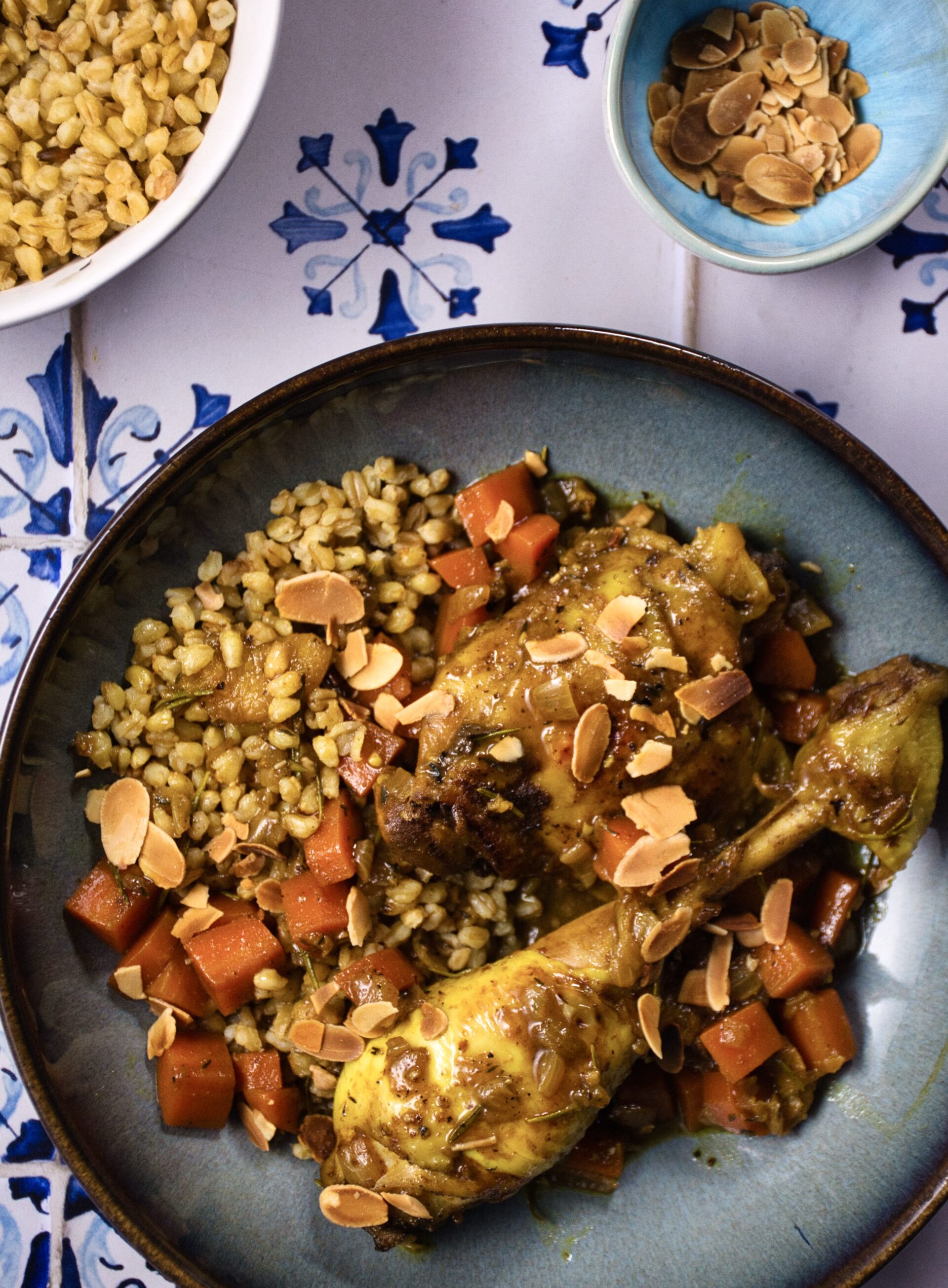
These one-pot, Middle Eastern chicken thighs are inspired by the sweet-and-savory tajines I discovered while living in France. Imagine juicy, succulent chicken thighs, fragrant herbs, tender carrots, and naturally sweet apricots, all tied together with the warm, complex flavors of a ras el hanout spice mix. Although the recipe may seem long at first glance, most of it’s hands-off and the prep is minimal.
A Closer Look at the Ingredients
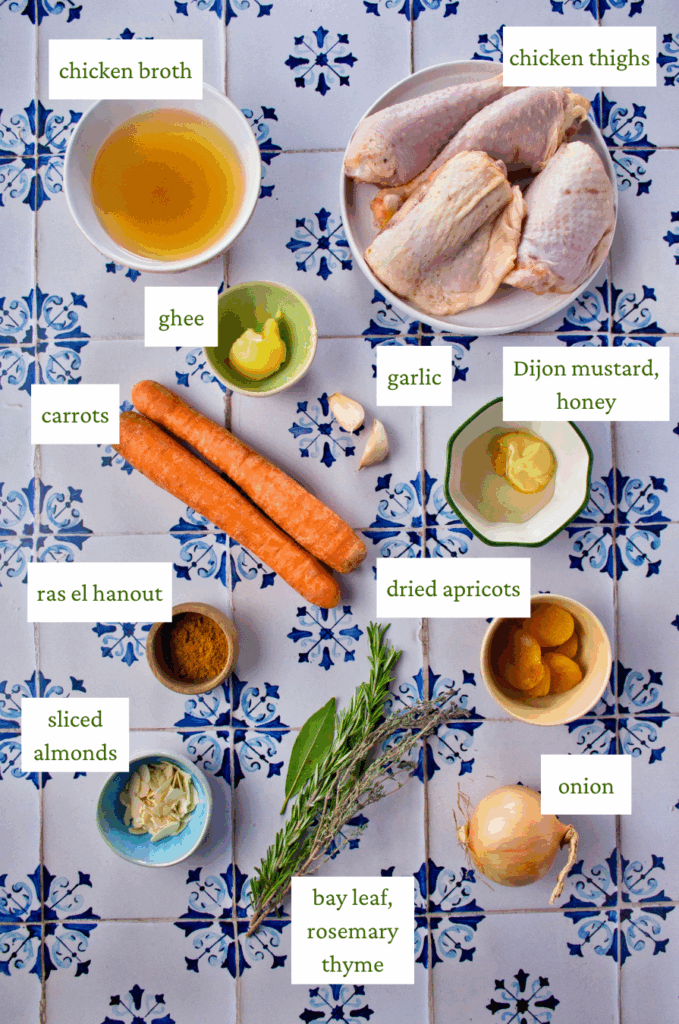
- Chicken thighs: Bone-in, skin-on chicken thighs are ideal for this recipe. In France, thighs are most commonly sold with the drumstick, so I used 2 thighs and 2 drumsticks, but I recommend using 4 thighs for more even cooking. The fat and juices from the skin and bones keep the meat moist during long cooking times, while the collagen and marrow add richness and depth to the sauce. Substituting chicken breasts isn’t recommended, as they lack the same flavor and juiciness.
- Ras el hanout: This North African spice blend literally translates to “head of the shop,” implying the best spices the seller has to offer. Variations are endless – mine includes ginger, turmeric, cumin, cinnamon, coriander, allspice, paprika, black pepper, cardamom, clove, nutmeg, and rose petals. Ras el hanout is the backbone of this dish, giving it aromatic warmth and subtle floral notes. You can find it at most grocery stores, including Whole Foods, Target, or Kroger. Don’t skimp on quality.
- Honey and Dijon mustard: These ingredients form the liquid part of the marinade. The honey helps caramelize the chicken surface slightly during searing, enhancing aroma and flavor, which then blends into the braising liquid. Sharp Dijon mustard adds tang and umami, balancing the sweetness of the apricots. Its acids gently break down proteins, helping the chicken stay tender and juicy.
- Dried apricots: A pantry staple that provides concentrated sweetness and a subtle tang. They soften into the sauce during braising, contributing to a deeper, more layered flavor.
- Carrots: Add a nice dose of vegetables and pair beautifully with ras el hanout, apricots, and rosemary.
- Fresh rosemary, thyme, and bay leaf: These herbs lend fragrant, earthy notes. Rosemary is the star, pairing beautifully with both the vegetables and the spice blend.
- Ghee: Used as the cooking fat for its high smoke point and rich, nutty flavor. Avocado oil is a great substitute.
- Onion and garlic: A classic aromatic base.
- Sliced almonds: Toasted and added at the end, they provide a nutty taste and crunchy texture that contrasts with tender chicken and soft vegetables.
- Chicken or vegetable broth: The braising liquid. Low- or no-sodium versions give you better control over seasoning.
How to Make My Middle Eastern Chicken Thighs (Plus Tips and Tricks)
Marinate the chicken thighs
Start by combining the ras el hanout, runny honey, Dijon mustard, and a pinch of kosher salt to make the marinade. Rub about ⅔ of the marinade all around the chicken, and under the skin. Let marinate at least 1 hour, or up to 24 hours for maximum flavor. Short on time? You can skip the marination and cook the chicken right away, and the result will still be delicious.
Prepare the other ingredients
Before you begin cooking, let the chicken come to room temperature for about 30 minutes. Dice your carrots and onions.
Heat the ghee in a large Dutch oven or heavy-bottomed pot over medium-high heat. The oil should shimmer and look wavy. If it’s smoking, it’s too hot, and you need to reduce the heat.
Place the chicken skin-side down and sear without moving it for about 5 minutes, until the skin is deeply golden and the chicken releases easily from the pan. Make sure not to overcrowd the pot, browning in two batches if necessary. Flip and brown the other side for a few minutes. Once browned, transfer the chicken to a plate.
Why this step is important: Browning the chicken adds richness to the final sauce, thanks to the Maillard reaction, a chemical transformation between sugars and amino acids. The browned bits at the bottom of the pot will later dissolve into the liquid, creating an incredibly flavorful base.
Sauté the carrots and aromatics
Reduce the heat to medium and leave the fat in the pan. Add the carrots and onions. Cook for 10 minutes, stirring occasionally, until the onions turn a light blond color and the carrots start releasing their sugars. If the onions start browning, reduce the heat to medium-low.
While the onions and carrots are cooking, press your garlic (or mince, if you don’t have a garlic press). Add the garlic and remaining marinade to the pan, stir well to combine, and cook for an additional 2 minutes, mixing often.
Why press the garlic?: While it may seam counter-intuitive, the more you crush or mince garlic, the stronger its flavor becomes. Pressing the garlic also allows it to distribute across the dish.
Slow simmer covered
Half the dried apricots and add to the pot. Tie the rosemary, thyme, and bay leaf together with kitchen twine, and place on top. No worries if you don’t have kitchen twine – just add the herbs as is.
Add the chicken on top of the vegetables and herbs, skin-side up.
Add chicken or vegetable broth so that the bottom half of the chicken is covered. The amount needed will depend on the size of your pot.
Bring to a low simmer. It is important not to boil or strongly simmer the liquid; it should produce small, slow bubbles. The trick to braising chicken thighs is to cook them low and slow. Cover for 40 minutes over very low heat, or until the chicken is tender. While chicken thighs are safe to eat when their internal temperature reaches 165°F (75°C), they become fall-off-the-bone tender between 185–195°F (85-90°C). If your chicken is not tender enough after 40 minutes, continue cooking it, without increasing the heat.
Troubleshooting tip: If you have an induction stove-top that gets very hot, even on the lowest setting, you may have trouble maintaining a gentle enough simmer (small, gentle bubbles rising to the surface every couple of seconds). If this is the case, you can braise the dish in the oven, uncovered, at 350°F (175°C) conventional / 325 F (160°C) convection, for about 40 minutes.
Reduce the sauce
Carefully remove the chicken from the pot with a spatula, set aside on a plate, and cover to keep warm.
Bring the sauce to a strong simmer, on medium or medium-high heat. Leaving the pot uncovered, reduce the sauce for about 20 minutes, or until it reaches your desired thickness.
Once thickened, reduce the heat to very low. Remove the herb bouquet. Add the chicken on back on top. Cover the pot, and reheat the chicken via steam, for about 5 minutes.
Meanwhile, toast the slivered almonds
Toast your slivered almonds to bring out their flavor.
Method 1: Heat a dry skillet over medium heat. Add the slivered almonds, stirring often, until golden and fragrant.
Method 2: In an oven preheated to 350F (175C), toast your slivered almonds in a single layer on a baking sheet or pan, for about 8 minutes.
Keep a close eye on the nuts to avoid burning.
Serve and enjoy!
Serve these Middle Eastern chicken thighs with the sauce and slivered almonds spooned on top.
I like to enjoy these middle eastern chicken thighs with barley.
Middle Eastern Chicken Thighs with Apricots, Carrots, and Rosemary
Equipment
- 1 Dutch oven with cover
Ingredients
- 2 tsp ras el hanout spice
- 1 Tbl honey
- 1 Tbl Dijon mustard
- 4 chicken thighs (bone-in, skin on)
- 1 Tbl ghee
- 2 carrots (diced)
- 1 yellow onion (diced)
- 2 garlic cloves (pressed)
- 5 dried apricots (halved)
- 2 fresh rosemary sprigs
- 3 fresh thyme sprigs
- 1 bay leaf
- 2-3 cups chicken broth (50-70 cl)
- handful sliced almonds
Instructions
- In a bowl, mix ras el hanout, honey, Dijon mustard, and a pinch of salt. Rub about ⅔ of the marinade all over and under the chicken skin. Marinate for at least 1 hour or up to 24 hours. If short on time, you can skip the marination.
- Bring chicken to room temperature for about 30 minutes. Heat ghee in a large Dutch oven over medium-high heat. Place chicken skin-side down and sear for 5 minutes, or until golden and skin releases from pan. Flip and brown the other side for 2 minutes. Transfer to a plate.
- Reduce heat to medium. In the same pot, add carrots and onions. Cook for 10 minutes, stirring occasionally, until softened. Add garlic and the remaining marinade. Cook 2 minutes, stirring often.
- Add dried apricots and a tied bundle of rosemary, thyme, bay leaf. Place chicken on top, skin-side up. Pour in broth until the bottom half of the chicken is covered. Bring to a very gentle simmer (small, occasional bubbles rising to the surface), cover, and cook for 40 minutes over very low heat, until chicken is tender (internal temperature of 185°F/85°C). See troubleshooting tips.
- Remove chicken with a spatula and reserve covered on a plate.Increase heat to medium and strongly simmer the sauce uncovered for about 20 minutes, until it thickens. Remove herb stems. Reduce heat to low and return chicken to the pot. Cover and steam 5 minutes to reheat.
- Meanwhile, in a dry skillet over medium heat (or in a 350°F/175°C oven for 8 minutes), toast slivered almonds until golden and fragrant. Watch closely to prevent burning.
- Spoon the sauce and toasted almonds over the chicken. Serve with barley or your preferred grain.
Did you make this recipe?
Please let me know how it turned out for you! Leave a comment below and tag @jessicahomekitchen on Instagram.
Looking for another Middle Eastern meal? You’ll love my one-pot Vegetarian Shakshuka.